Healthcare · Clinical Speed · HealthPortfolio.ai

Medical software for hospital revenue and patient health.

Healthcare is the center of our engineering. Clinical Speed executes hospitals' payer contracts in software, from the chargemaster to the remit, and HealthPortfolio.ai gives patients a clear, coded reading of their own health records.

Clinical Speed financial dashboard
Clinical Speed
HealthPortfolio.ai on a phone
One contract engine
Before the 837 leaves, after the 835 returns
835837Report-only
01Clinical Speed · Hospital revenue integrity

Contract-aware revenue integrity across the claim lifecycle.

Clinical Speed digitizes every payer contract a hospital submits. Engineers and contract analysts code every value on every page, including fee schedules, rate columns, modifier rules, bundling rules, carve-outs, stop-loss terms, lesser-of provisions, case rates and per diems, and each model is effective-dated so a remittance is priced on the rate sheet in force on its date of service.

The platform then runs that contract logic against the hospital's own 837 claims and the payers' 835 remittances, line by line, and every finding cites the clause, the fee-schedule cell and the rule behind it, so the hospital can defend the finding because the finding is the contract. Clinical Speed is report-only by design and never writes back into the hospital's systems, and this governance is why hospital finance, compliance and IT teams can adopt it.

Clients run from about $75M hospitals to multi-billion-dollar health systems. References are offered case by case during initial discussions.

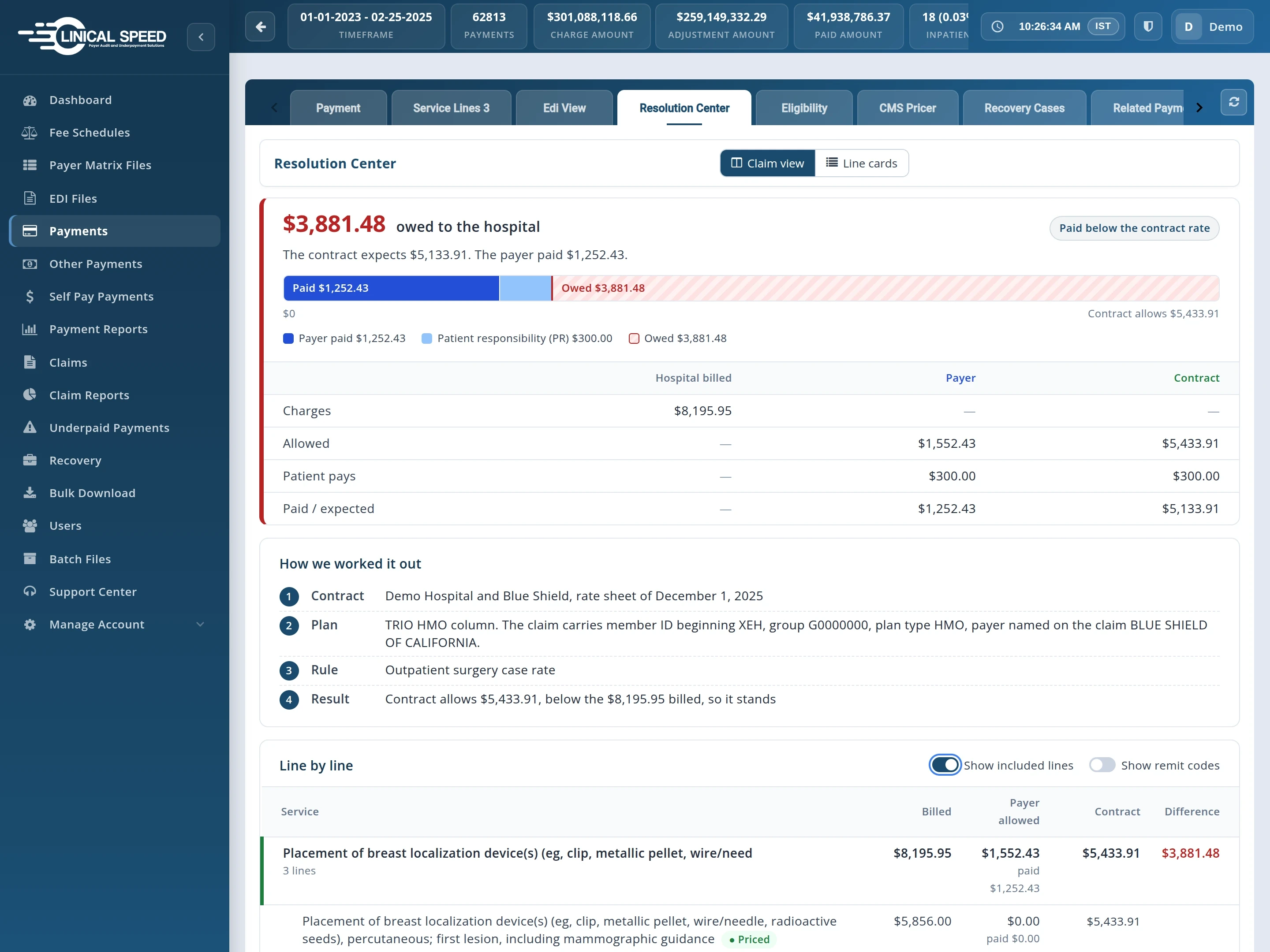
clinicalspeedaudits.comClinical Speed Resolution Center line cards that cite the rate column and the rule
Live
Resolution Center line cards cite the rate column and the rule for every claim line.
Evidence

The finding is the contract.

Governance

Hospitals adopt what they can defend, and Clinical Speed is report-only by design.

Cash

Cash that never leaks is more valuable than cash recovered late.

02Three products, one contract engine

Three products on one contract engine, from the chargemaster to the remit.

One executable copy of each contract runs before the 837 leaves and after the 835 returns, and each product answers one question. Every finding cites the clause or the guideline behind it. Clinical Speed reports, and the hospital decides.

Clinical Speed underpaid line in the Resolution Center
835

Underpayment Audit

Did the payer pay what the contract says?

Each 835 remittance is priced against the contract across a 12 to 24-month lookback. Underpaid lines are proven, documented and recovered through appeal, and lines paid above the contract go to the hospital's compliance office. Every finding cites the clause and the fee-schedule cell behind it, so the hospital can defend it.

Line-level variances · AI-written appeals · overpayments to compliance
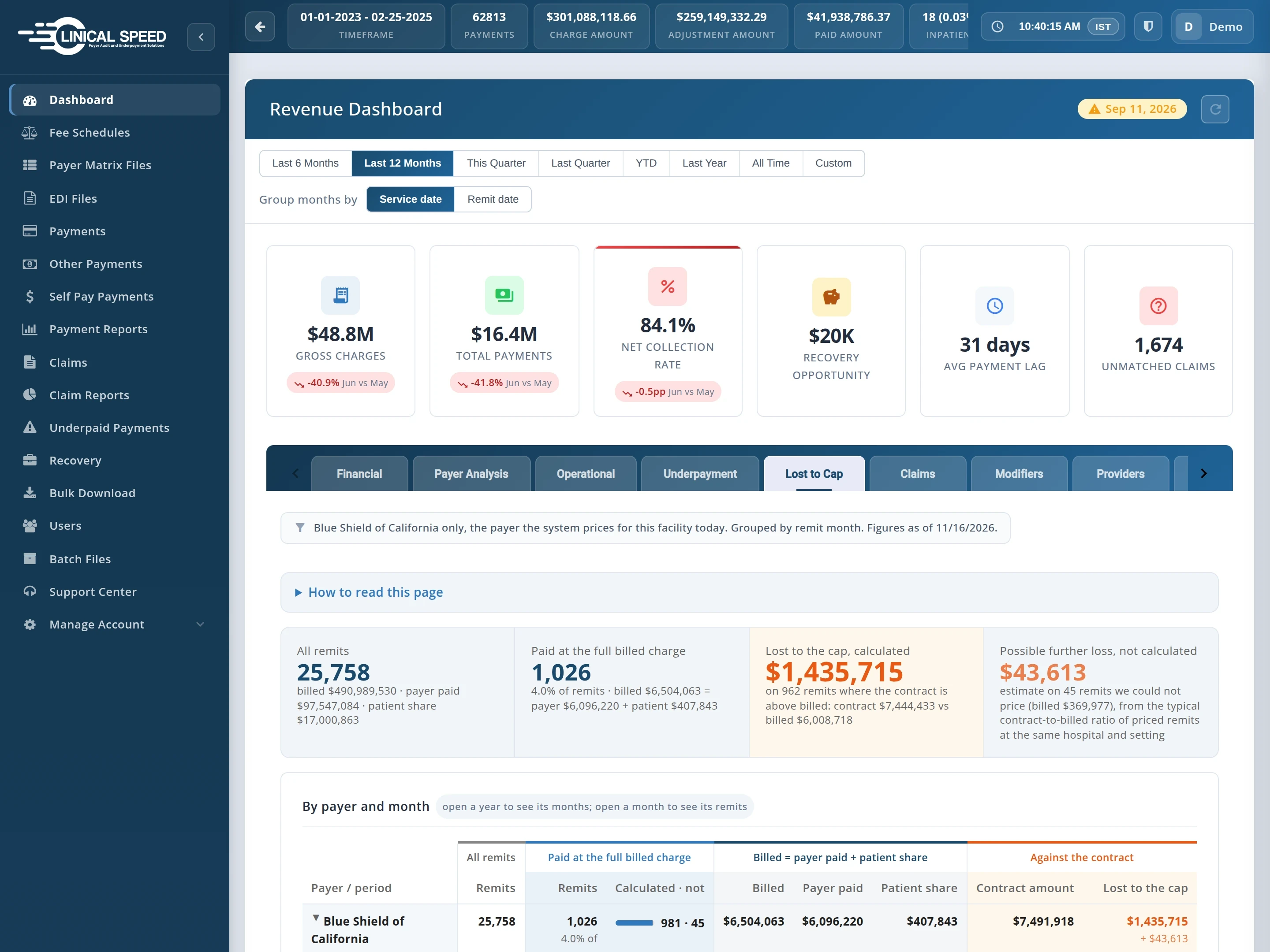
Clinical Speed Max Allowable Audit, Lost to Cap view
CDM

Max Allowable Audit

Did our own charge cap what the contract allows?

Your chargemaster against your contracts. Lost to Cap measures where a lesser-of clause let a charge below the contract set the payment. Contract Basis quotes the clause behind each service line, with the charge history and a rationale for the chargemaster committee. The fix is a uniform chargemaster change for every payer.

Lost to Cap · Contract Basis · Pre-Submission Contract QA
EI

Encounter Integrity

What's missing from the claim and from the care?

The Missed Charge Audit finds documented services that never reached the claim, contract-priced for the hospital's review and corrected through late charges and corrected claims. The Care Gap Review sends guideline-cited gaps in care to the treating clinician, who decides. It is built for patient follow-up and never touches a claim.

Missed Charge Audit · Care Gap Review · sold together
How hospitals start

Most begin with the Underpayment Audit. Once a payer's contract is coded, the same 837s and 835s let Clinical Speed present Max Allowable and Encounter Integrity findings on the hospital's own data, before anything new is installed. Underpayment recovery is contingency-based, with no setup fee and nothing owed if nothing is recovered. The Max Allowable Audit and Encounter Integrity carry a one-time installation and training fee plus contingency, set in the proposal.

03Code-policy expertise

With every contract and fee schedule loaded, Clinical Speed knows code policy payer by payer.

Clinical Speed's team is expert in underpayments, and because each client's contracts and payer fee schedules are coded into the platform, the team is expert in code policy itself: how each payer treats each code under each contract.

  • Fee schedules and rate tables across the full lookback
  • DRG and APC grouping, with CMS IPPS and OPPS pricing on every payment
  • Modifier logic and modifier-dependent pricing
  • Bundling, unbundling, NCCI pairs and multiple-procedure reductions
  • Carve-outs, outliers, stop-loss and lesser-of provisions
  • Timely-filing windows and documentation thresholds
  • Plan columns identified from the member ID prefix
  • Payer-specific failure patterns learned from each contract's adjudication history
04AI in the recovery pipeline

Thousands of reason codes an hour, each one tied to the contract.

Our AI writes the reason codes and justifications for every underpaid 835 line, thousands an hour, from the structured policy we code out of each hospital's digitized payer contracts and payment schedules. Each reason names the clause, the rate column, the rule and the calculation, and the platform packages them into payer-specific appeals routed toward payer compliance pathways.

Nothing moves to appeal until the hospital has reviewed the findings.

Clinical Speed payer-specific appeal templates
05Case study · one client, one payer

What one audit found for one client.

One example, not a projection. For a two-hospital system in California, Clinical Speed digitized every contract, fee schedule and program the system holds with a single commercial payer, then matched twelve months of that payer's 835 remittances to the system's 837 claims and ran both audits.

45,591
Claims from that one payer, matched and priced in this audit
$1.53M
Underpaid by that payer on 1,391 claims, packaged for appeal
$4.4M+
A year the client’s own charges left behind, billed below what the contract allowed. Fixed going forward, not by appeal
$492,877
Already past that payer's filing deadline, documented for the client's legal team

One client, one commercial payer, twelve months of claims and remittances, 2026. Shown without the client's name. Every hospital's contracts and results differ.

06HealthPortfolio.ai · Personal health intelligence

A patient's health records in one place, read in plain words.

HealthPortfolio.ai is the health portfolio we built for patients and the people who care for them. A patient brings lab results, medications and records into one account, and the platform explains each result against its reference range, compares results across dates and keeps a timeline of the patient's health.

An eight-step intake of about 10 to 15 minutes feeds our clinical engine, which maps symptoms to ICD-10-coded conditions with match scores, and an AI assistant answers questions from the patient's own records and shows its source.

healthportfolio.aiHealthPortfolio.ai patient dashboard
Live
8
Health workspaces, from labs and vitals to medications and mental health
15
Languages, including Spanish, Arabic, Hindi and Chinese
70+
Privacy filters that strip identifiers before any AI request
100
Quick answers and 19 short videos built into the app
07The clinical engine

Rule-based clinical analysis, with an AI expert-panel mode on top.

Medical Codex

A Bayesian differential engine maps the patient's symptoms to ICD-10-coded conditions, each with a cardinal-symptom match score and a plain explanation of how the score was built, so the patient can take the reasoning to their doctor.

Diagnostics and labs

Diagnostic tests are ranked by clinical urgency and pre-test probability, and blood labs are flagged against reference ranges, compared across dates and linked to the ICD-10 conditions they help confirm or rule out.

Risk and interactions

Risk is scored with the Framingham, ASCVD, STOP-BANG, KDIGO and ATP III models, drug interactions are checked through CYP450 pathways, and screenings follow USPSTF 2024, ACS, AHA/ACC and ACOG guidelines.

AI-Enhanced mode

Seven purpose-built specialist-panel prompts review a de-identified case summary and return 10 to 15 differential diagnoses in a strict format, for review by a licensed clinician. Every identifier is stripped before the request leaves our system.

HealthPortfolio.ai provides educational information and clinical decision support. It does not diagnose and does not replace a licensed clinician.

Put your contracts to work, or see the platforms first.

Hospital revenue leaders can request a Clinical Speed demo today, and qualified reviewers can see every healthcare platform under NDA.